
Financial Stability and Monetary Policy Committees’ Decision
According to the NBG’s Financial Stability Committee’s decision, the cyclical component of the countercyclical capital buffer remains unchanged. As of March 2026, banks maintain healthy capital and liquidity indicators. Annual growth of credit portfolio, excluding the exchange rate effect, amounted to 14.9% in March 2026, with business loans once again driving the growth. As of the first quarter of 2026, credit-to-GDP ratio remains below its trend, which results in a negative gap. The strong economic growth observed in the first quarter of 2026 contributed to the widening of the negative gap. According to the Committee’s assessment, as economic growth normalizes and credit activity remains sustainable, the credit-to-GDP ratio will gradually approach its long-term level. Therefore, at the current stage, there is no need to change the cyclical component of the countercyclical capital buffer. Moreover, commercial banks continue to gradually accumulate the neutral countercyclical capital buffer.
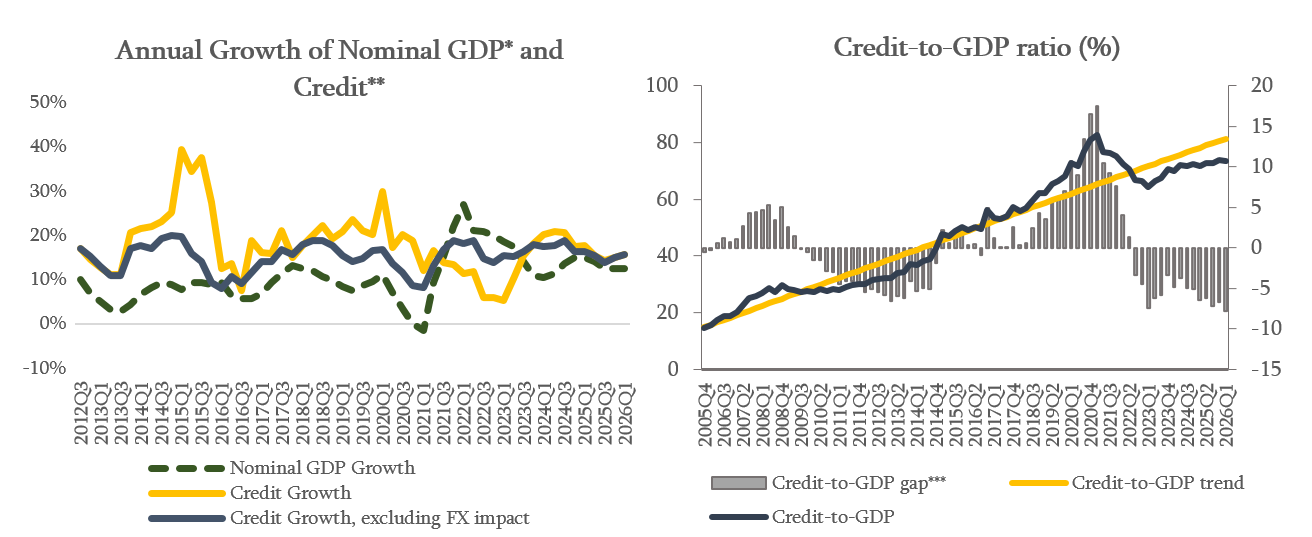
Source: NBG, Geostat
*Nominal GDP growth reflects the YoY GDP growth of the last 4 quarters.
**Credit includes loans directly issued by commercial banks, microfinance institutions and loan issuing entities, as well as bonds issued domestically by the non-financial sector.
***Credit-to-GDP gap is the deviation of credit-to-GDP ratio from its long-run trend. The trend is estimated using HP filter in line with the Basel recommendations.
The Georgian financial sector remains resilient and continues smooth lending to the economy. Over the past year, global financial conditions have been relatively stable and favorable. However, the outbreak of conflict in the Middle East led to a moderate tightening of global financial conditions. Although, from a historical perspective, conditions remain relatively accommodative, against the backdrop of heightened uncertainty, the risks of commodity market shocks, strengthening of global inflationary expectations, and further tightening of financial conditions are elevated. In light of the above circumstances, the Financial Stability and Monetary Policy Joint Committee considered it appropriate to return the temporarily raised upper limit for the minimum reserve requirements for funds attracted in foreign currency to its previous level, reducing it by 5 percentage points. This requirement constitutes a central bank’s instrument and NBG will continue to recalibrate it in the future in accordance with macroeconomic conditions and circumstances. Apart from that, mitigating the risks stemming from financial dollarization remains an important objective of the National Bank. Consistent with its declared policy, the NBG, in coordination with the industry, and taking into consideration macroeconomic environment and risks, as well as the potential effect of the reserve requirement adjustment, continues implementing the long-term de-dollarization plan. According to the Financial Stability Committee’s decision, the limit on unhedged foreign currency loans increases from 750,000 GEL to 1,000,000 GEL, effective from July 1, 2026.
The National Bank of Georgia continues monitoring the country’s financial stability and assessing domestic and foreign risks. If necessary, it will use all available instruments to minimize potential risks.
The Financial Stability Committee’s next meeting will be held on September 30th, 2026.