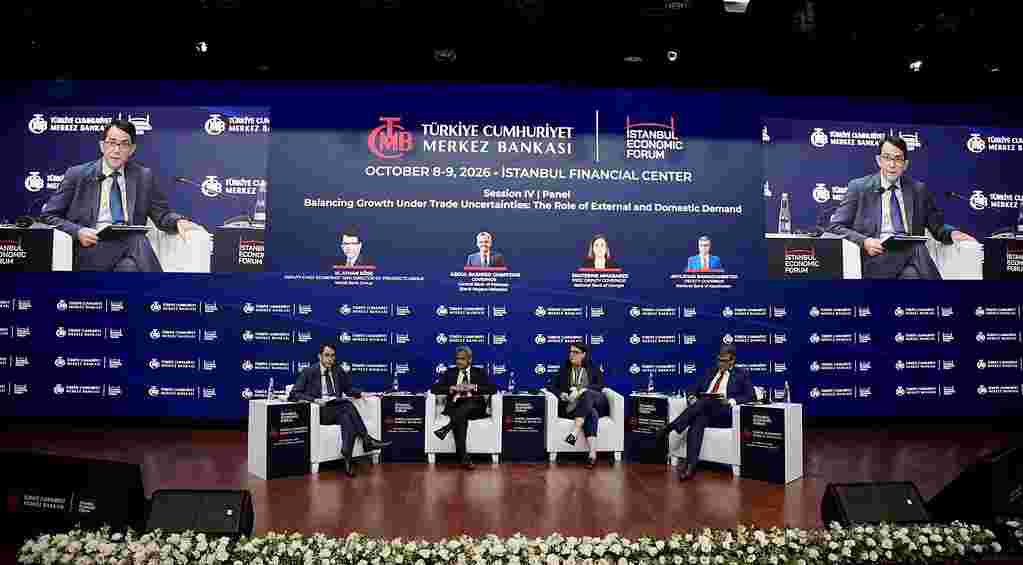
Ekaterine Mikabadze Participated in the Istanbul Economic Forum
Ekaterine Mikabadze, First Vice Governor of the National Bank of Georgia, participated in the Istanbul Economic Forum.
The Forum brought together central bank governors, finance ministers, senior policymakers, and representatives of academic institutions.
During the event, participants discussed the key challenges facing the global economy and pressing issues in macroeconomic policy.
Ekaterine Mikabadze took part in a panel discussion titled “Balancing Growth Under Trade Uncertainties: The Role of External and Domestic Demand,” which explored changes in the global trade environment and the challenges facing small open economies.
The panel also featured Abdul Rasheed Ghaffour, Governor of the Central Bank of Malaysia (Bank Negara Malaysia), and Akylzhan Baimagambetov, Deputy Governor of the National Bank of the Republic of Kazakhstan.
The panelists discussed how central banks can foster economic resilience amid global uncertainty within their respective mandates. Key priorities identified included price stability, a credible monetary policy framework, a flexible exchange rate, adequate international reserves, and the preservation of financial stability.
Ekaterine Mikabadze noted that global developments affect the Georgian economy not only through direct trade linkages but also through external demand, financing conditions, capital flows, the exchange rate, and investor sentiment.
The First Vice Governor emphasized that consistent macroeconomic policies and credible institutions are the foundation of economic resilience in such an environment. An inflation-targeting regime and a flexible exchange rate help the economy adapt to external shocks, while adequate international reserves provide an additional buffer and reinforce confidence.
The discussion also focused on a risk-based approach to monetary policy. As Ekaterine Mikabadze explained, under conditions of heightened uncertainty, policy decisions should be based on an assessment of alternative scenarios. Transparent communication of these scenarios helps the public and financial market participants understand how the central bank will respond to changing economic conditions, thereby helping to anchor inflation expectations and enhance policy effectiveness.
“Regional agreements and improved transport connectivity facilitate market access and reduce trade-related costs. However, they cannot replace a predictable, rules-based multilateral trading system. Shifts in global trade flows and supply chains may create new opportunities for countries with reliable infrastructure, efficient logistics, and sound macroeconomic policies. Nevertheless, amid global trade uncertainty, growth cannot rely solely on a single market, sector, or policy instrument. External diversification, stronger domestic productive capacity, flexible adaptation, and credible macroeconomic institutions are mutually reinforcing,” the First Vice Governor of the National Bank of Georgia stated.
The Istanbul Economic Forum was held at the Istanbul Financial Center and organized by the Central Bank of the Republic of Türkiye. The Forum has developed into a platform for high-level dialogue and knowledge sharing on international economic and monetary policy issues.