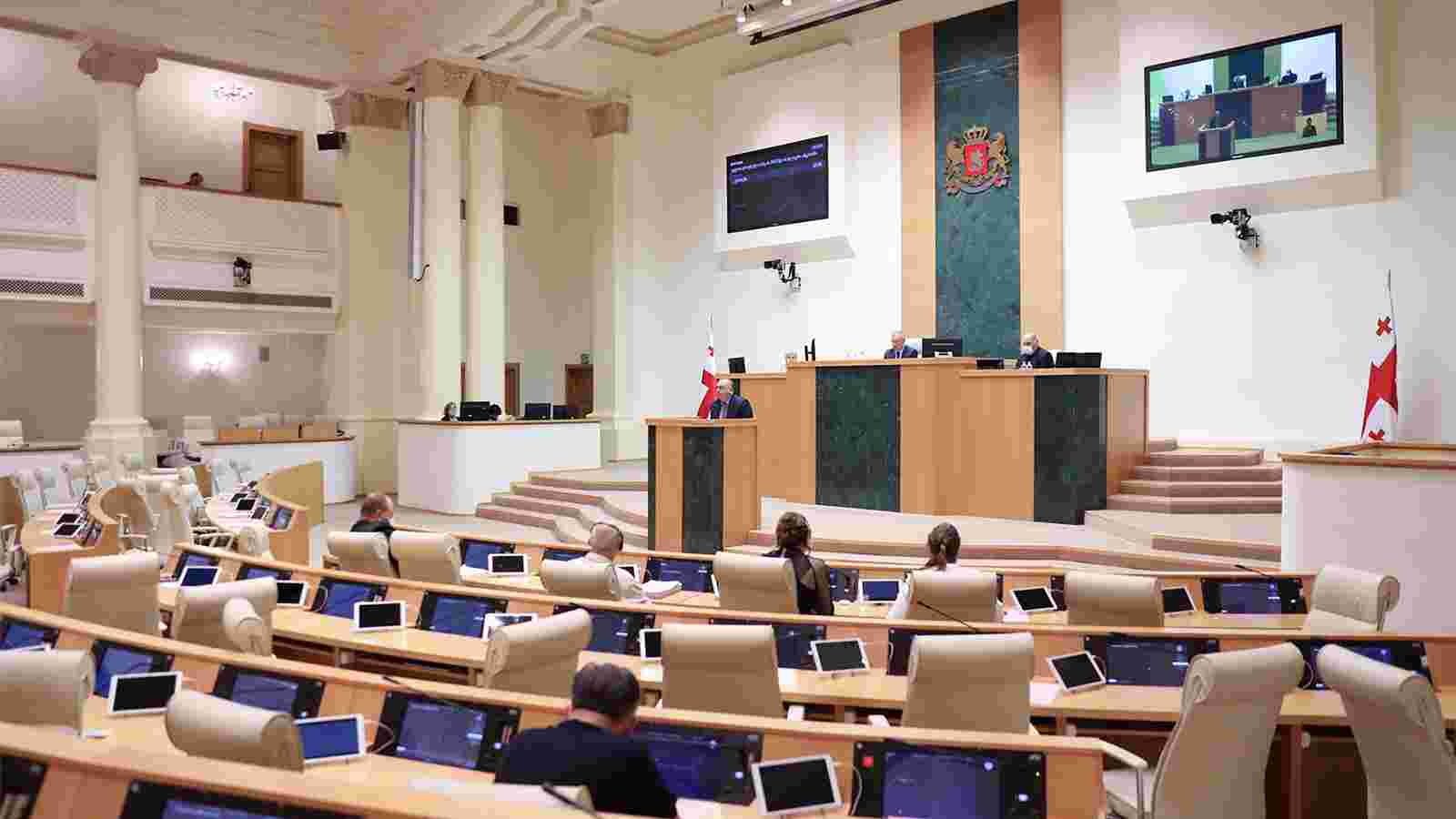
The Parliament Hears the 2020 Annual Report of the National Bank of Georgia
Koba Gvenetadze, Governor of the National Bank of Georgia, presented the NBG’s 2020 Annual Report to the plenary session of the Parliament.
The National Bank report includes a review of monetary, foreign exchange and supervisory policies and audited financial statements. In addition, the report details the National Bank's specific actions addressing the challenges of the coronavirus pandemic worldwide.
Governor Gvenetadze provided an overview of the Central Bank’s priority areas for the reporting period. "As you know, the primary task of the National Bank is to support the sustainable macroeconomic environment by safeguarding price stability and fostering the stable functioning of the financial sector in the medium term. Price stability, in turn, implies the availability of a level of inflation in the medium term that is optimal for high and sustainable economic growth in the long run. Focusing on the medium term is particularly important as inflation in the current period or in short term may deviate from the target (both upward and downward). However, the policy pursued by the National Bank will make sure that it returns to the target in the medium term, thus achieving price stability," - Governor Gvenetadze noted.
Further, Governor discussed details of the challenges facing the world and the economic impact of the pandemic. "By identifying, assessing and monitoring systemic risks, the National Bank is pursuing a response policy to reduce these risks, thereby enhancing the resilience of the financial system. The additional capital requirements imposed by the National Bank in recent years and the profits made by commercial banks have enabled banks to accumulate adequate capital buffers. As a result, they were prepared to face the challenges of COVID-19. The banking system handled the pandemic with sustainable asset quality in 2020, backed by the regulation on responsible lending and a number of macro-prudential measures to reduce the dollarization of loans. The establishment of Net Stable Funding Ratio (NSFR) and Liquidity Coverage Ratio (LCR) contributed to the sustainability of banks' funding sources and the solidity of the liquidity buffer. As an effort to mitigate the negative impact of the pandemic on the financial sector and to stimulate the national economy, the National Bank of Georgia developed a supervisory plan to ease capital requirements for the banks," - the NBG Governor stated.

Koba Gvenetadze underscored the role the National Bank of Georgia plays in the development of the financial market. He informed the audience that the National Bank of Georgia is developing various supervisory approaches, thus helping to create a basic Fintech infrastructure. Our Open Regulation Framework, the Regulatory Laboratory, the Digital Banking Framework, fast payments and intensive work on digital lari projects would be good examples. Getting remote financial services has become especially relevant in pandemic. The Regulatory Laboratory enabled innovative financial institutions to experiment with artificial intelligence-based facial recognition technologies and to use them in financial services. To encourage remote financial services, the National Bank declared its readiness to license digital banking, offering greater flexibility of the digital banking process, with the digital banking model and risks in place. The open banking project is especially meaningful In terms of intensified technology and competition," - Governor Gvenetadze noted.
The steps taken by the National Bank, the timeliness and adequacy of its policy were highly regarded by a number of reputable international organizations: rating companies, the International Monetary Fund, the World Bank, the Asian Development Bank, the European Bank for Reconstruction and Development and others. "Maintaining the rating in such a difficult and challenging period is due to the success that Georgia has achieved with a consistent macroeconomic policy in the face of the current pandemic and global uncertainty, despite growing external risks. The successful refinancing of Eurobonds is another success story. The Eurobond coupons, despite the global risks, has decreased by about 2.5 times compared to the 2011 issue (from 6.875% to 2.75%)," Governor added.
Koba Gvenetadze noted towards the end of his speech, that the National Bank of Georgia remains committed to a timely and legitimate policy that is adaptable to environment. This task often requires unpopular but much needed actions. He said that even in 2020, the timely actions and policies of the National Bank, against the backdrop of the unprecedented shock, played a key role in mitigating the negative impact of the pandemic on the economy.
Governor of the National Bank of Georgia was pleased to answer the questions of the deputies after the presentation.